What Are the Best Desk Accessories for Small Spaces?
What Are Desk Accessories for Small Spaces?
When you ask people to help you find the best desk accessories for small spaces, what they’re usually asking is: “Please help me de-clutter. Relief from messy desk, discomfort, constant disturbances and the perception that their workstation is actively working against them. Small desks don’t have to fail because they are small; they have to fail because the way you brace and support them is terrible.
In small places, every accessory becomes magnified. A good one can double your desk pleasure. A bad one can make it seem unusable. That’s because selecting desk accessories for small spaces isn’t about trends or aesthetics; it is all about deliberate, problem-solving.
The perfect desk accessories are the type that subtly fade into your workflow. They don’t demand attention. They aren’t taking up space for nothing. Instead, they take away friction you didn’t even realize was sapping your focus. A small keyboard that brings your hands closer together. A monitor stand that elevates your screen and gives your desk some breathing room. A light that lights exactly what you’re working on, the way it helps most and nothing more in between.
This guide is intended for real-life setups: apartment desks, bedroom corners, shared rooms, student spaces, and small home offices. You don’t need a bigger desk or a complete overhaul. You require clever, space-conscious upgrades that acknowledge the limitations of your setup while greatly enhancing how it feels to work within.
Because, when your desk no longer fights you, focus happens naturally.
👉Explore Setup Upgrade Accessories
Contents
- 1 Small Desks and Why Concentration Collapses
- 2 Desk Plan for Deep Focus in Tight Quarters
- 3 Ways to keep a small desk area organized without clutter
- 4 Smart home office accessories that take up almost no space
- 5 Lights & Comfort For Long Hours
- 6 Best compact keyboard for small desks
- 7 Best wireless mouse for small desktop space
- 8 Tech Accessories That Make Small Desks Feel Less Cluttered
- 9 Space-saving monitor stand recommendations
- 10 The best desk lamp for small workspaces
- 11 Top small desk tech gadgets for non-gimmicky workplace fun
- 12 Focus Accessories That Actually Help
- 13 How to enhance focus in a small desk setting
- 14 Sound & Diversion Catch in Close Space
- 15 Is It Worth Getting Desk Accessories for Small Spaces?
- 16 What is in a Small Workspace Setup ( Quick Checklist )
- 17 Closing Thoughts on the Small Desk, Big Difference
Small Desks and Why Concentration Collapses

Focus doesn’t just get lost randomly; it erodes very slowly. They work faster at a small desk, where there isn’t much margin for error. A slightly awkward keyboard position. A lamp that casts shadows. A mouse that is always banging against the edge of the desk. Individually each of these issues is relatively minor, but collectively they cause sustained low-level strain.
Eventually, your brain will realize these things even if you don’t. It has to work harder and compensate, adjust to and ignore its discomfort. Eventually that mental effort becomes fatigue, restlessness and poor concentration. That’s why even the motivated and disciplined among us find it hard to stay on task at a tiny desk.
Small desks demand precision. When the layout isn’t planned, you are making micro-decisions all day long, where to put your hands; where to move things; how to sit. That mental noise distracts from what you should be doing. Understanding why focus breaks down is the first step to fixing it, and explains why the right accessories can make such a big impact.
Before we can get into products, it’s important to understand why small desks just feel harder to work at.
A messy or poorly designed desk creates daily micro-distractions:
- You’re always shifting things around
- Your arms feel cramped
- Bad lighting is causing your eyes to strain
- You subconsciously feel “boxed in”
Your brain perceives this as stress, even though you may be stationary.
That’s why small workspace desk organization is so important. In a tight area everything has to pull its weight. Accessories categories are to eliminate any kind of friction, not inundate the eye.
The best desk accessories for small spaces accomplish three things:
- Free up surface area
- Improve comfort without bulk
- Reduce decision fatigue and distraction
Done right, even a small desk can feel serene, efficient, and relatively spacious.
👉Ideal If Your Desk Feels Crowded
Desk Plan for Deep Focus in Tight Quarters
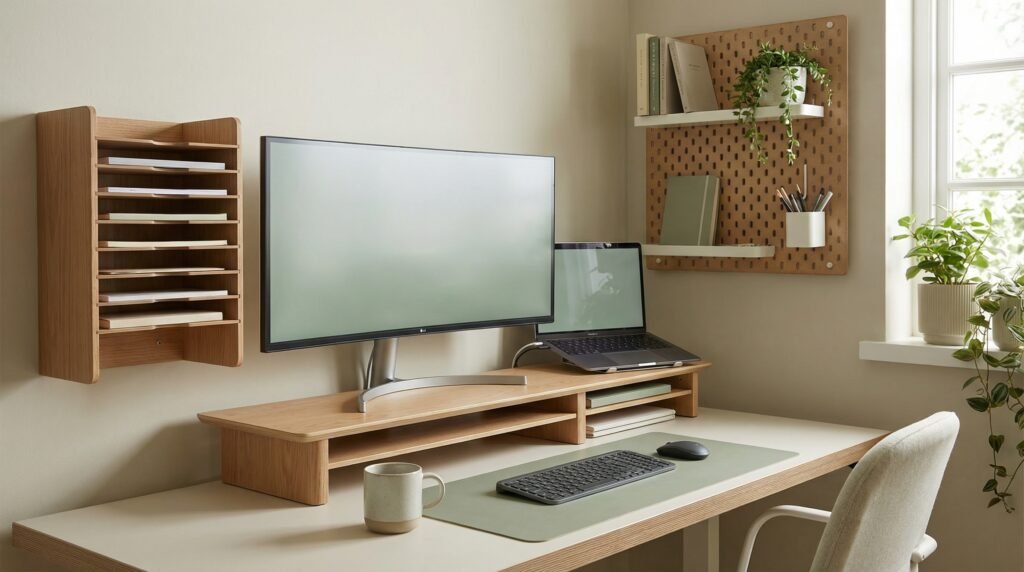
Small desk organization ideas you cannot resist
The deep focus does not come from the desk, but is what we bring to the desk. In small spaces, design matters more than storage. It isn’t about squeezing all (or even most) of what you own onto the desk; it’s about creating a setup that accommodates how your body and brain actually, naturally function.
The best small desk organization ideas focus on zones. One input zone (keyboard, mouse). One for viewing (screen). One for thinking or writing. The problem, of course, is that if these zones overlap or vie for territory with one another, attention suffers. “When they’re crisply defined — even across a small area, the desk feels more at peace and controlled.
Leverage vertical space time and again here. Elevating your monitor, mounting accessories or stacking storage clears the horizontal space where work actually happens. The great layouts feel practically boring at first glance, and that’s a good thing. Boring desks don’t distract. They invite concentration.
This chapter lays the groundwork for all that is to come. Because once your layout manifests focus, everything else you add will make sense in a way that doesn’t seem cluttered.
The number one mistake that people make is trying to organize on top of the desk instead of around the desk.
For deep focus, your desk surface should feel open (even if it’s not that big).
So the best small desk organization ideas consider vertical space, hidden storage and furniture you can use in more ways than one.
Here’s what consistently works:
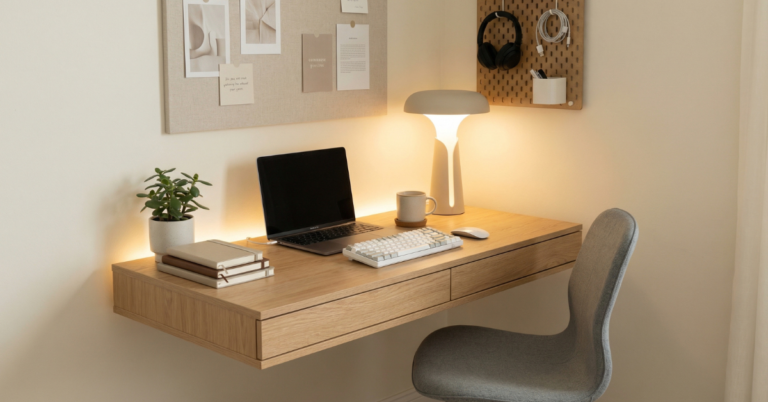
- Lift your screens up from the desk (monitor stand/ arm)
- Push storage upward (shelves, pegboards)
- Arm-reach: Keep things you use on a day-to-day basis here.
If you can’t see where to put down your hands, notebook or mouse, your desk is overloaded.
Ways to keep a small desk area organized without clutter
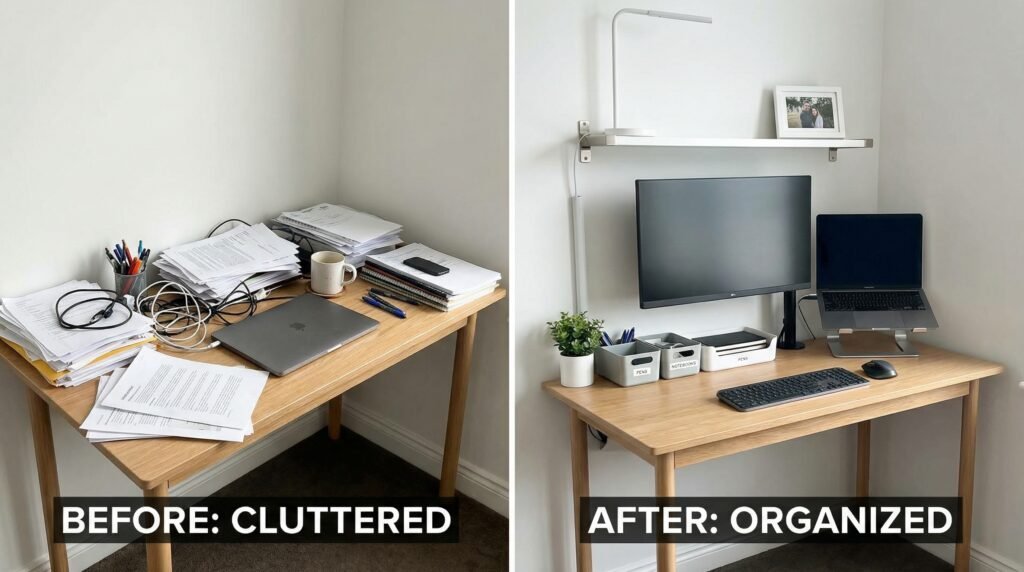
Because organizing a small desk is not about adding organizers, it’s about getting rid of excess. Clutter accrues when things don’t have clear purposes or only static homes. On a tiny table, that issue is immediately apparent.
How to organize a small desk space Think in reverse When you’re scoping out the best ways to organize a small desk, it’s best to start from use. What do you touch every hour? Every day? Once a week? Daily used items should be within a hand’s reach. Everything else needs to go off the desktop and away from the main workspace, either vertically downward, underdual monitor setupneath or off of the desk completely.
Clutter isn’t just physical, after all; it’s also visual. Too many colors, cables or an assortment of accessories will distract ▼ the user from your work. An empty desk does not need to be pristine, but no more than anyone else’s that is filled A clean desk never needs to be cluttered. This section goes over the mentality you’ll need to subtly change in order to take organizational stress from something you constantly fight and turn it into something you only do once.
To discover how to organize a small desk area, first remove everything, yes, everything.
Then reintroduce the following items:
- Keyboard and mouse
- Screen(s)
- One Surface to write on ( either paper or tablet)
- One storage solution
Anything more than that should be suspect.
Ask yourself:
“Is this helping me work better, or is it just sitting here?”
Most small desks simply shift with that change of perspective alone.
Smart home office accessories that take up almost no space
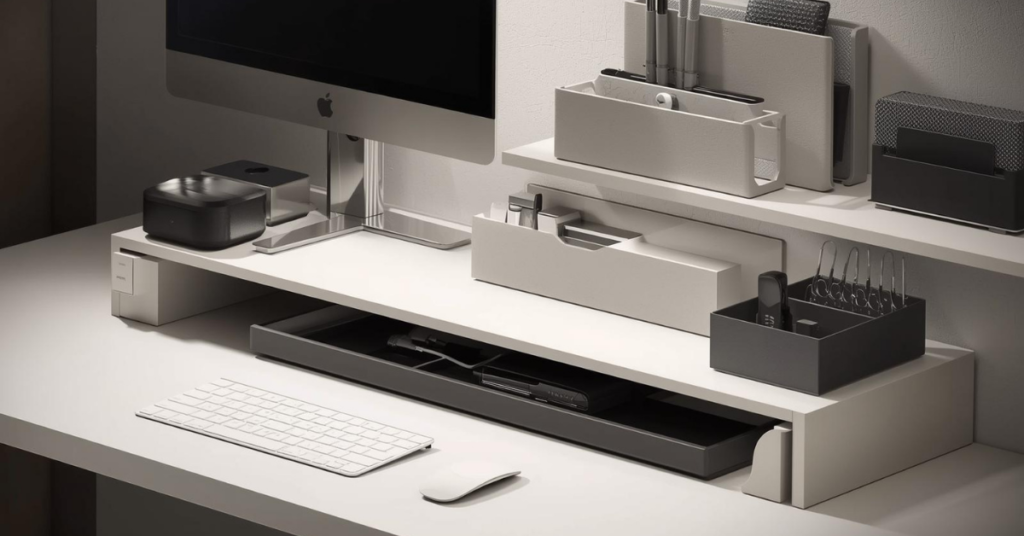
Not all of those accessories deserve to take up room on a small desk. In fact, most don’t. Those that deserve their spot are there to solve problems: not enough surface area, poor ergonomics, cable hell or a lack of workflow efficiency.
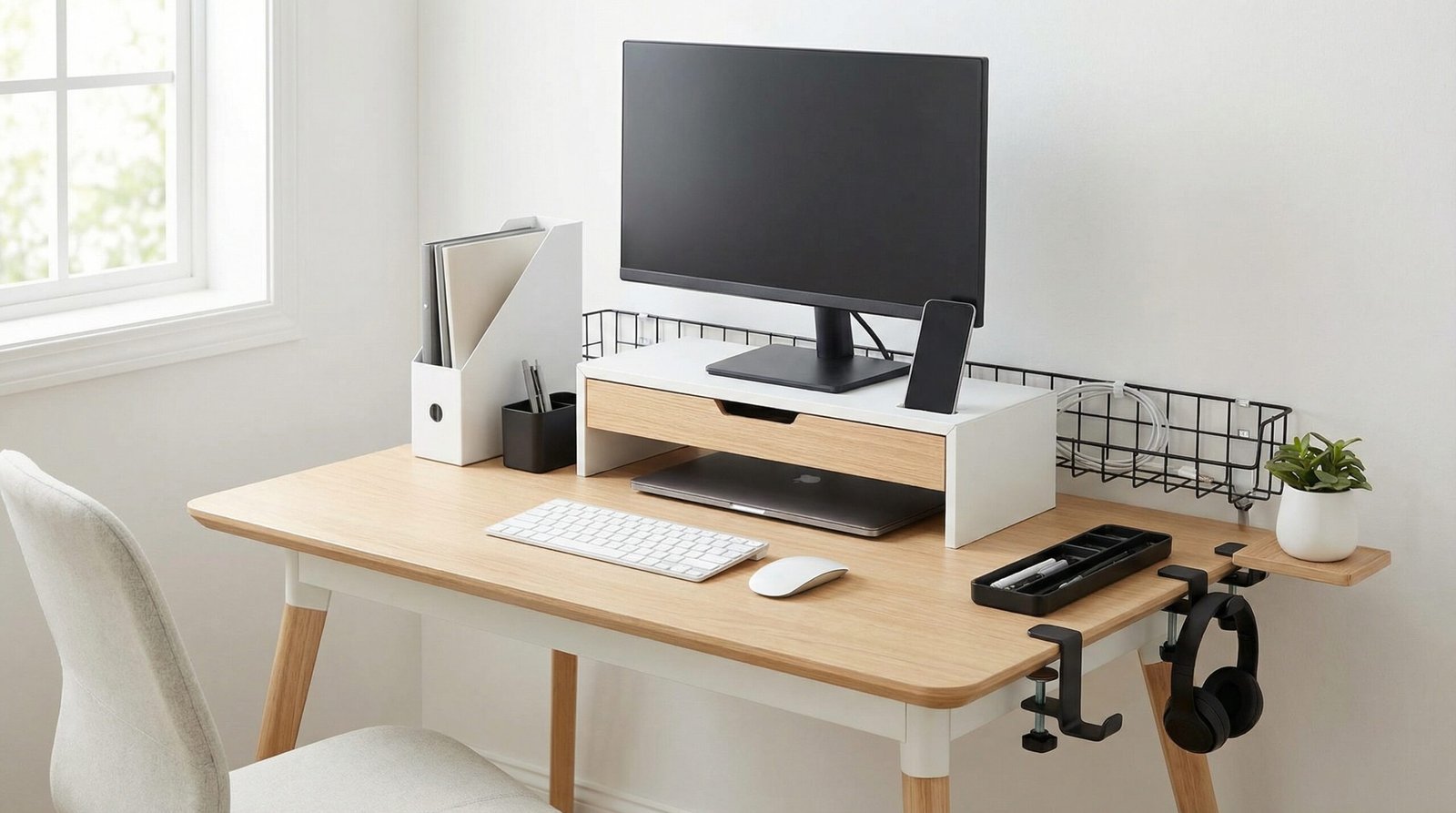
Space-efficient home office accessories aren’t like regular desk gear. These bins are built to do more with less: They’re a marriage of storage, support and organization in one footprint. Consider accessories that rise up, slink away, clamp or fold, rather than spread.
In a small environment, functionality trumps looks. An accessory should explain itself every time to sit down to work. If it doesn’t save time or reduce friction or add comfort, then there’s no point. In this section we outline the qualities that distinguish real space-saving accessories from decor clutter.
All accessories are not of the same caliber. In tiny interiors, the winners swapped in for several or took something away altogether.
High-impact space-saving home office accessories are:
- Monitor stands with space saver storage underneath
- Cable trays under desk
- Thin keyboard drawers that slide in under the keys
- Clamp-on fixtures, rather than free-standing ones
These refinements don’t just tidy up — they change how the desktop feels to work on.
These upgrades clear distractions at their source. View Best Option for Small Desks →
Lights & Comfort For Long Hours
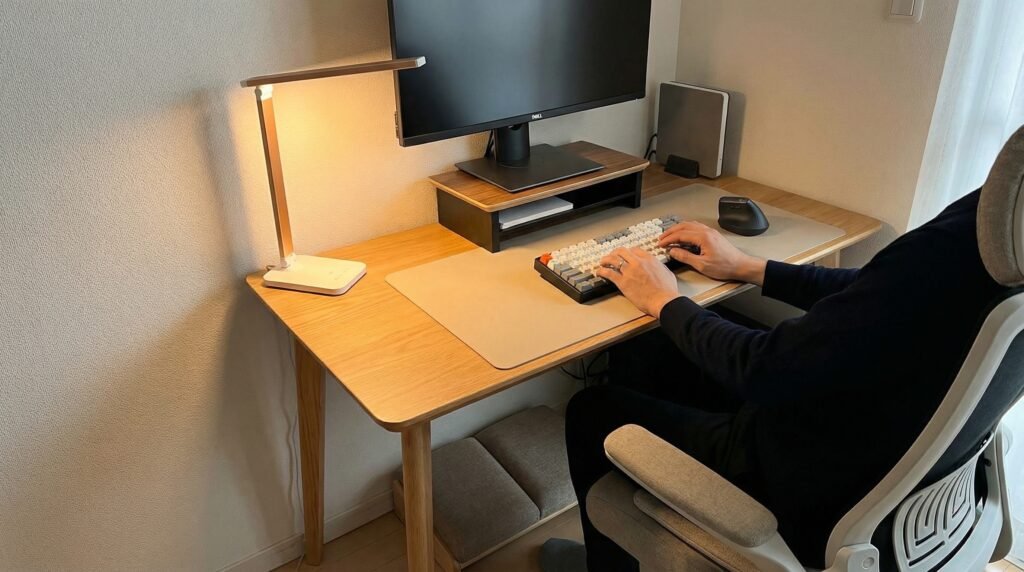
When you wok in long sessions all the weaknesses of your desk set up are on full display. Poor lighting strains your eyes. Bad posture builds tension. Awkward angles turn into aches. In tight quarters, such considerations can get sidelined because ergonomic implies many-machine bulk.
They don’t.
Today’s ergonomic add-ons for the small desk are unobtrusive, mousy looking and surprisingly effective. Subtle changes, screen height, wrist alignment, foot placement, can have a huge impact on how long you can work comfortably. Lighting also is an equally important factor that can influence more than just ability to see, but mood and energy as well.
This section also introduces the idea that ergonomics isn’t about perfection; it’s about eliminating unnecessary strain. Somehow, when your body is well-supported, it frees up your brain to be more focused and creative.
Comfort isn’t optional. If you are physically tense, that’s where your attention will go.
The thing with ergonomics in compact spaces is that you want to avoid heft. Luckily, many of these ergonomic gear in small desk setup are getting smaller and minimalist.
Prioritize:
- Neutral wrist positioning
- Proper screen height
- Feet planted comfortably
A complete ergonomic overhaul isn’t required, just tweaks that are smart.
Best compact keyboard for small desks
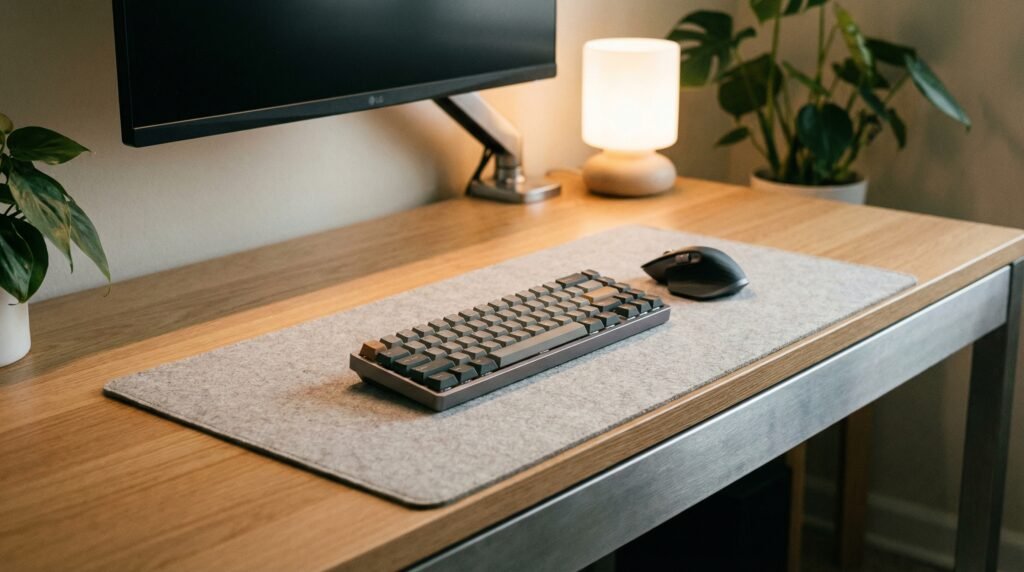
Keyboards quietly dominate desk space. Not only does a keyboard in full size hog too much space, it also forces your hands and shoulders into wider, less comfortable angles. It’s also one that, on a small desk in the middle of your living room, can add up to a whole lot of tension and fatigue.
Solution-compact keyboards Eliminate this issue without minimizing the capabilities. By cutting off unused keys and tightening up its layout, they’ve placed everything closer to your natural resting place. The result is more mouse space, better posture and a desk that feels less crowded.
This is where this section explain why keyboard size is more important than you think and how selecting the perfect compact keyboard can transform a small workspace by enhancing not only comfort but also fucus.
A full-size keyboard takes up too much valuable footage, and requires awkward arm positioning.
The best compact keyboard for small desks is generally:
- 60% or 75% layout
- Low-profile keys
- Wireless or single-cable
Compact keyboards pull your mouse in closer, reduce shoulder strain and provide more real estate for actual work.
If you’re a daily typer, this is one of the best ROI upgrades you can make.
👉One of the Most Practical Picks
Best wireless mouse for small desktop space
In confined areas, the mouse movement feels slower and rougher. You don’t have space for big wild swings or non-stop repositioning, which means that the quality of a mouse is much more important than its size alone.
The wireless mouse best for a small desktop size gives you accuracy without needing more real estate. It has good tracking on any surface, it fits comfortably in the hand and cable drag will not hinder performance during fast movements. A great mouse eliminates micro-frustrations you may not even know you’re ignoring.
This section will explain why the rights mouse can silently change how smooth and controlled everything feels at work—especially on smaller desks.
In tight areas, control is more important than size.
Best wireless mice for limited desktops
The best compact mouse for small desktop space should:
- Track well on small surface
- Fitting your hand without claw grip the mouse.
- Say no to dragging wires on the table
It’s not until you upgrade to a better mouse that many people realize just how much tension their old mouse creates.
Like Also consider this under desk foot rest for small space.
Feet are the most overlooked aspect of desk ergonomics, especially in cramped setups. When our feet aren’t resting comfortably, posture adjusts for it—our hips slide, shoulders scrunch, and so goes focus.
Low profile under desk foot rest which is just high enough to be effective for your needs of under desk leg support. It steadies your lower body, supports sitting up straighter and reduces the strain during those long sessions. Because it slims down any boxy office footrest, Slim designs slip under an area without taking over.
This section explains why our foot position is more important than many realize — and just how much a slight change can improve comfort.
Hanging feet or legs crumpled beneath a desk slowly wreaks havoc with posture.
Under Desk Small Space Footrests: Fiberglass Or Neoprene A footrest for under desk small space aids in:
- Stabilizing your lower body
- Taking the strain off of the lower back
- Improving circulation during long sessions
- Seek narrow, angled shapes, not fat cubes.
It’s one of those accessories you don’t realize you need … until you do it.
Tech Accessories That Make Small Desks Feel Less Cluttered
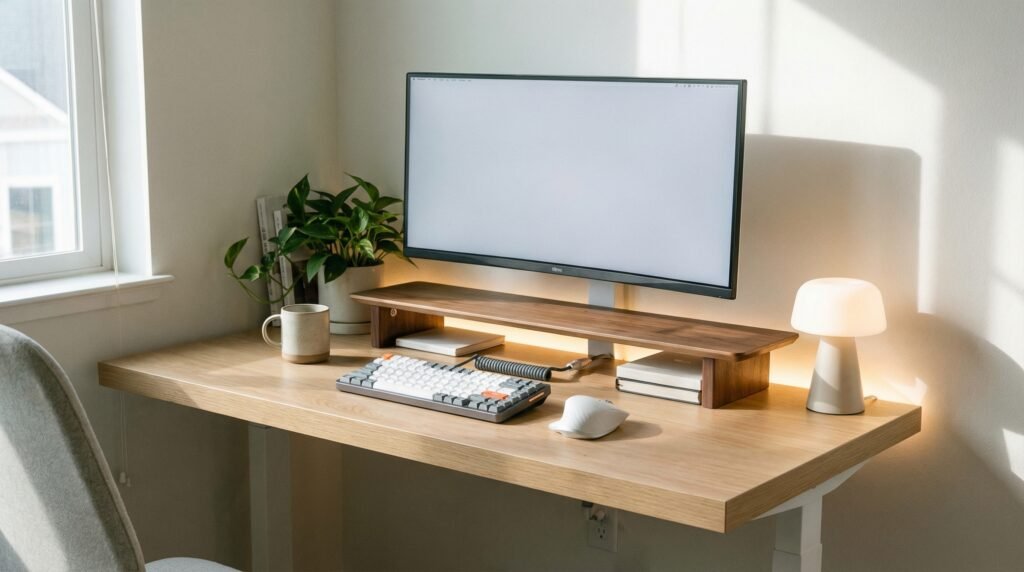
A compact wireless charging pad for a clutter-free desk
Technology can clutter a desk; technology can clean up a desk. In other words, the difference is just cables, or lack thereof, in cramped spaces. Chargers, adapters and power bricks consume visual space more quickly than you may think.
Compact wireless charging pad cuts down on cable sprawl, helps create predictable charging habits and keeps often-used gadgets close to hand without adding clutter. The desk feels cleaner, not because things disappear but because stuff gets managed more efficiently.
This section introduces tech accessories that don’t take up megadesks; they make a small desk roomier, more efficient or just plain lovelier.
Best wireless charging pad for a small desk
Cables are visual clutter. Even in tidy arrangements, they demand attention.
The pad wireless charger for a compact work space just takes the place of:
- Phone charger
- Watch charger
- Earbud cable (on combo pads)
Drop your device. Pick it up later. No thought required.
Less friction = better focus.
Space-saving monitor stand recommendations
A monitor that lies flat on a desk squanders your vertical potential. It restricts posture, obstructs usable space and makes everything else conform to it.
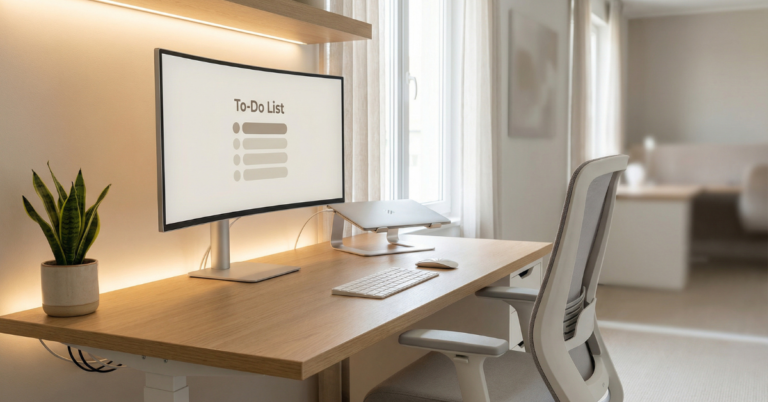
Monitor risers that save space are a solution to multiple problems at once. They raise the monitor screen to a more comfortable height, allowing you to have space under it for your storage or ornamental elements. In small settings, this one adjustment can totally change how open the desk feels.
This segment explains why monitor elevation is one of the single biggest improvements for small work spaces.
Our best monitor arm suggestions are primarily for space saving:
- Rt rush higher With the screen at eye level
- Creating usable space underneath
- Maintaining stability without bulk
Extra credit for one with a drawer or shelf.
With this one change, you can lay claim to as much as 30% of your desk space!
The best desk lamp for small workspaces
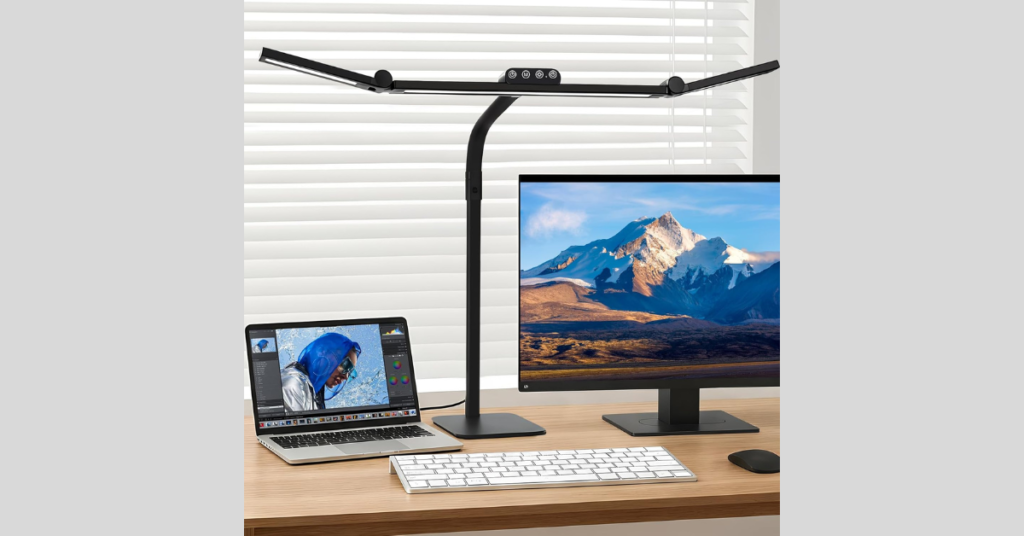
Light has influenced the feel of a workspace long before you realize it has. Dim light makes a desk feel small and weak. Even the tiniest desk looks intentional and inviting in good lighting.
The best desk lamps for small workspaces direct attention where it’s necessary and don’t spill light over the entire space. They’re adjustable, they’re compact, and they work efficiently, meant to help rather than overwhelm the distracted desk.
This section of the column describes why lighting should be given much as thought as furniture, especially in reduced-size setups.
More so than many people think, lighting affects mood, focus and eye strain.
The best desk lamps for small workspaces include:
- Adjustable (arm or head)
- Directional, not ambient
- Compact by way of a powerful clamp or base
Steer clear of lamps that scatter light in all directions. Directed light maintains focus on your workspace.
Top small desk tech gadgets for non-gimmicky workplace fun
What little desks want isn’t more gadgets; it’s better gadgets. A lot of tech accessories promise productivity but only complicate things.
The gadgets that really make a difference are simple, dependable and space-friendly. They’re there to streamline the process, speed things up or automate them. In small installations, utility must have primacy over novelty.
This section posits the distinction between gimmicks and genuinely useful tech, and reveals how to sniff out the keepers.
Not all gadgets are worth it, but some are really helpful.
Some cool top small desk tech gadgets are:
- USB-C hubs with vertical orientation
- Smart cable organizers
- Small wall clocks with temperature display
- Noise-reducing desk fans
Anything that saves time, space or mental effort gets a spot.
Focus Accessories That Actually Help
What are some small desk productivity accessories?
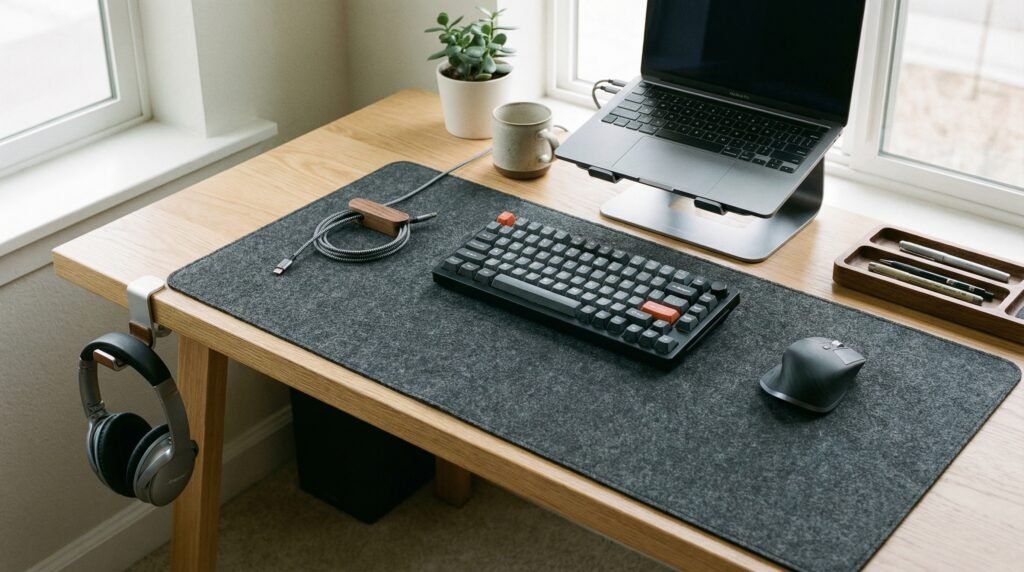
Productivity accessories are not about doing more, they’re about removing barriers. At such a small desk, any inefficiency becomes apparent.
The peripherals aiding small desk productivity are generally invisible when they’re doing their job properly. Cable clamps that prevent cords from sliding. Holders that hold essentials right where they should be. Save time on searching, adjusting, or rethinking tools.
In this section we introduce a focus-first lens on accessories, one where mental clarity supersedes visual appeal.
Productivity isn’t about putting more in, it’s about taking obstacles out.
So, what are the desk accessories for small desks that help the most with productivity?
The ones that:
- Reduce reaching and repositioning
- Minimize visual clutter
- Keep tools right where you need them
Examples:
- Magnetic cable clips
- Vertical file holders
- Under-desk headphone hooks
Taken together, they eliminate the small points of friction, and those add up.
👉View Space Saving Desk Accessories Aamzon
How to enhance focus in a small desk setting
Better focus in a tiny desk setup is not about discipline; it’s about design. It is easier to stay focused when you are in an environment conducive to concentration.
Good and bad design choices are magnified by small desks. Cause of fast add placement, consistent placements and clear surfaces + predictable layout Your brain has less to record. The reward is that the brain dials down when it doesn’t have to keep hitting refresh.
This section covers applied ways of aligning your desk with the actual way that focus operates.
Congesting your desk can clump up your mind, too.
To keep focused on a tiny desk:
- Maintain open the middle of your desk
- Confine what is visible to work materials
- Use consistent placement (nothing “floats”)
Your brain loves predictability. Once it knows where everything lives, it eases up.
Sound & Diversion Catch in Close Space
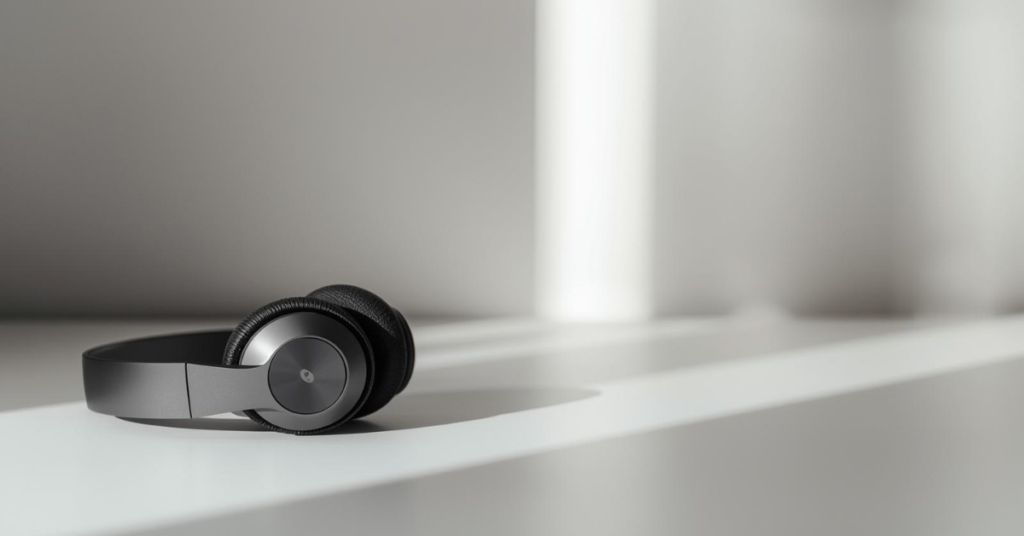
Small desks are concealed in areas that are not regularly quiet, such as shared bedrooms, living rooms or bustling households. Sound morphs with itself into the silent productivity killer.
Managing noise doesn’t have to be all or nothing. Other times it’s about softening it, covering it up and keeping it from breaking focus. The slightest shift can register in tight quarters.
This part presents practical ways to manage distraction, without having to completely re-engineer your setting.
You want to avoid working at small desks in group or loud spaces.
To manage distractions:
- Use compact noise-canceling headphones
- Include a little desk mat to dampen sound
- Keep surfaces clear to minimize the visual chaos
Even small gains here can mean doubling the amount of time you’re able to maintain focus.
👉Improve Your Work Environment, Cancel the Disturbing Noises
Is It Worth Getting Desk Accessories for Small Spaces?
This is a reasonable question and the answer is nuanced.
When space is at a premium, it’s easy to wonder if desk accessories are worth investing in. It’s all about intent That is a purely intention based answer.
Accessories that solve real problems, comfort, organization, focus? When they’re selected for appearance alone, utility goes out the window in a matter of days.
This chapter repositions desk accessories as useful not decorative tools, thus enabling readers to make clear decisions on what actually deserves the space.
Do desk accessories matter in a small space?
Yes, if they solve a problem.
No, if they’re purely decorative.
The best accessories:
- Replace bad habits
- Improve posture
- Reduce daily frustration
Picked intentionally, they don’t clutter your desk, rather they make space for you to think.
👉A Smart Upgrade for Tight Spaces
What is in a Small Workspace Setup ( Quick Checklist )
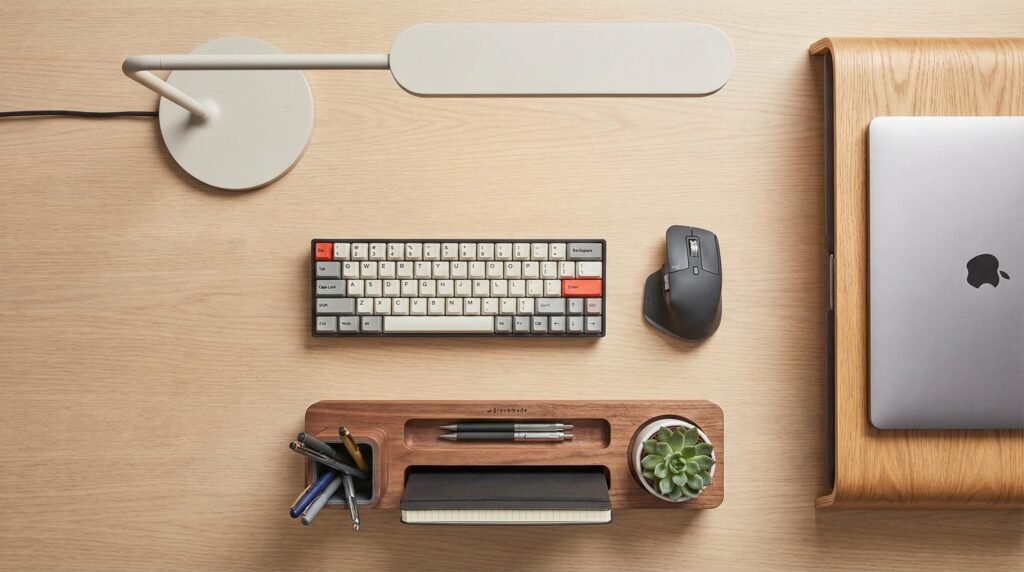
The thought of beginning from scratch can feel daunting. A checklist makes decisions less overwhelming and helps to prevent overbuying.
A small, well-conceived work space doesn’t require dozens of objects. It requires a handful of select essentials that play nicely with each other. The following section will build an old-standard-conforms-max basis setup, that is decent for comfort, focus and effectiveness without much waste.
If you’re starting from scratch, here’s a basic but very successful foundation:
- Compact keyboard
- Wireless mouse
- Monitor stand or arm
- Focused desk lamp
- One smart storage solution
- Cable management system
Start here. Add slowly.
These desk upgrades take distractions at the source, and allow your desk to work with you, not against you.
Closing Thoughts on the Small Desk, Big Difference
A tiny desk is not a constraint; it’s a focusing device. It forces you to be intentional about what you bring into your workspace. And it turns out that if you make those decisions thoughtfully, things are powerful.
The greatest shifts don’t come from piling on more. They come from removing friction. When your hands just naturally land on the keyboard and your screen is at a good height and the light seems to fall just right, focus ceases to be something you chase. It becomes the default.
Most people are surprised at how quickly they see a difference. One accessory can alter how you stand. One little rearrangement can calm the noise in your head. Over time, those small changes add up to better workdays and less fatigue.
You don’t need perfect setup. You require a setup that honors your space, your body and your attention. Small desks require little thinking — and they yield big rewards.
When your desk is cooperating with you rather than fighting you, even the tiniest nook can host decorum and deep satisfaction.
A tiny desk is no disadvantage. It’s a limit, and limits make for better choices.
When every item in your space is intentional, you foster a calmer, cleaner and more efficient workspace. Focus improves. Fatigue drops. Work feels lighter.
And you needn’t have everything listed here.
You just need the right few.
Ready to Repair Your Small Desk for Good?
No, it’s not that you’re undisciplined; it’s just that your desk is so fucking overbearing. If your workspace feels cluttered or crowded or awkward or distracting in any way, that might have something to do with the fact that you are drowning under a pile of random detritus and trying to work at the same time. The right desk accessories don’t add clutter; they cut friction off at its source.
Rather than a place to force productivity, upgrade the tools that quietly govern how you work every day. A smarter keyboard. Better lighting. Desktop accessories that help space (on your desk and in your brain).
👉 Begin with one upgrade that cures your most serious frustration today.
When your desk is alert and supportive, everything else becomes attainable.
👉Work Longer Without Discomfort
Still deciding? Read this Tech Accessories Pillar Tutorial.